Calder and the Reinvention of Sculpture
What makes Alexander Calder feel perpetually contemporary is that he fundamentally altered the relationship between sculpture, movement and space. Before Calder, sculpture was largely understood through permanence, mass and monumentality. Calder introduced instability, air, rhythm and chance — transforming sculpture from a fixed object into a living spatial experience.
The current exhibition at Fondation Louis Vuitton reveals just how radical this shift truly was. Calder’s mobiles are often described as playful, but their historical significance runs far deeper. Emerging during a period shaped by industrialisation, aviation, engineering and the destabilisation of traditional certainties, Calder responded to a world increasingly defined by motion and flux rather than permanence.
At a broader cultural level, Calder belongs to a generation reshaping how reality itself was understood. Einstein had destabilised fixed notions of space and time; modernism was reducing form toward abstraction; engineering and mechanisation were redefining ideas of structure and balance. Calder absorbed these transformations and translated them into sculpture.
What distinguishes the mobiles is not simply movement, but the way surrounding space becomes part of the work itself. Air currents, shadows and shifting balance continuously alter the composition. The sculpture never fully settles into a single image. In this sense, Calder replaces static form with perpetual variation.
The exhibition also highlights the importance of the Cirque Calder, which remains one of the artist’s most visionary achievements. Constructed from wire, fabric and found materials, the miniature circus transformed sculpture into theatre, choreography and performance decades before performance art became established historically. Beneath its humour lies an extraordinary understanding of timing, movement and human observation.
There is also a strong dialogue throughout the exhibition with earlier sculptural traditions, particularly Brancusi. Like Brancusi, Calder pursued reduction and clarity of form, yet where Brancusi sought stillness and purity, Calder introduced volatility and movement. One pushes toward timeless concentration; the other toward dynamic instability.
What ultimately makes Calder endure is the extraordinary balance within the work itself: intellectual yet accessible, engineered yet poetic, rigorous yet joyful. Even today, the mobiles retain a remarkable lightness that feels almost defiant against the weight and anxiety of contemporary life.
More than half a century later, Calder still feels less like a historical figure than an artist who anticipated many of the central concerns of contemporary art — participation, space, movement, temporality and the dissolution of boundaries between disciplines.
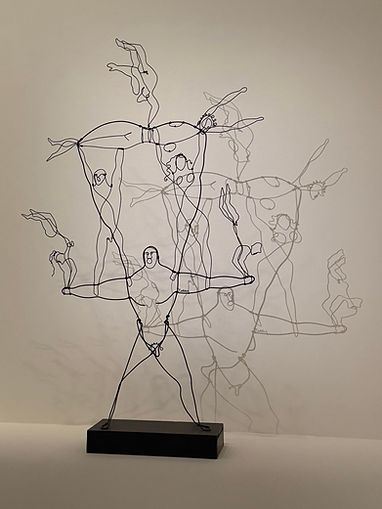
Alexander Calder, wire sculpture, Fondation Louis Vuitton, Paris - May 2026.